Walking around Caen

Amici, I fear I have been increasingly neglectful of this blog. Other things have been occupying my mind and my time. I haven’t progressed through half my trip yet, though! How silly.

One of my favourite things to do in Europe was to walk through the streets alone with only a sketch of an idea where I was going. In Caen, after viewing Matilda’s church and the great fortress, I was pretty keen on finding William’s abbey. The weather was not especially congenial, as I’ve mentioned before, but it felt like an authentic Norman experience and I am no stranger to rain having grown up in a coastal city.

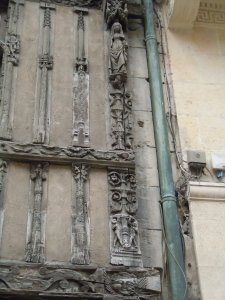
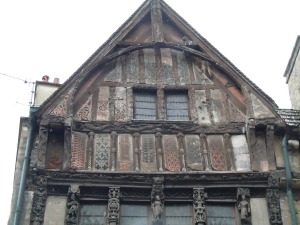
There are several things that caught my attention as I made my way to the abbey, and I will display a few below, but what truly delighted me was a building dating from the early Renaissance with a period wood façade. Among the stone buildings, it stuck out like a sore thumb. I will copy out what the plaque said in English:

Built at the beginning of the 16th century, these two houses are particularly noteworthy for their decoration which juxtaposes flamboyant Gothic and Renaissance style. As stone is abundant in Caen, house fronts were rarely timber-framed. The left-hand house belonged to a rich Caen merchant, Michel Mabré, an alderman of the town in 1509.

DSCN3724

The detailing is marvellous:

DSCN3727 DSCN3728 DSCN3731


About the windows:

DSCN3732

I’m amazed it’s lasted so long:

DSCN3729

DSCN3737Continuing my walk, I passed by Notre-Dame-de-Froiderue, a church whose foundation dates to before AD 1000, which was rebuilt in the 12th and 14th centuries and has seen many changes since then. The exterior has suffered quite a bit, whether by inclement weather or by human agency (quite possibly the former), and the stained glass windows have been lost.

Some medieval faces still remain, however:

DSCN3744

Alright, I’m exhausted (seriously, these photos take forever to upload and I am a terribly impatient person). That’s it for today, except one curious thing I found on the Rue Froide side of the church (which road, by the way, appears on charters dating to the twelfth century!):

DSCN3739

Inspiration Strikes!

Alas, not for my thesis. But on the way home from a workshop, running through the rain, a little tune sprang to mind. As I so often do, I started elaborating on it and adding words, and before I knew it I had a song in my head! As soon as I got home, I grabbed manuscript paper and ran to the piano to scribble down my tune, and then painstakingly I sketched out some basic harmonization and embellishments (it’s now been many years since I studied or wrote music, or even played it!). I am very quite content with it for my first composition in years. It is called Sanctus.

Caen: Wherein I betook myself on a self-guided walking tour and made up a lot of history

Let us begin this blog post with the disclaimer: I cannot guarantee a mite of the history I will recount is true. Indeed, I would highly caution against it. Forsooth, I would scratch the “hi” and rather call it a nice “story.” Let me glibly dismiss all challenges with a gentle cough that sounds almost like “not my era,” though of course I would never admit to being so lazy. Let’s engage in some bad writing, too, just to emphasize further the inaccuracies.

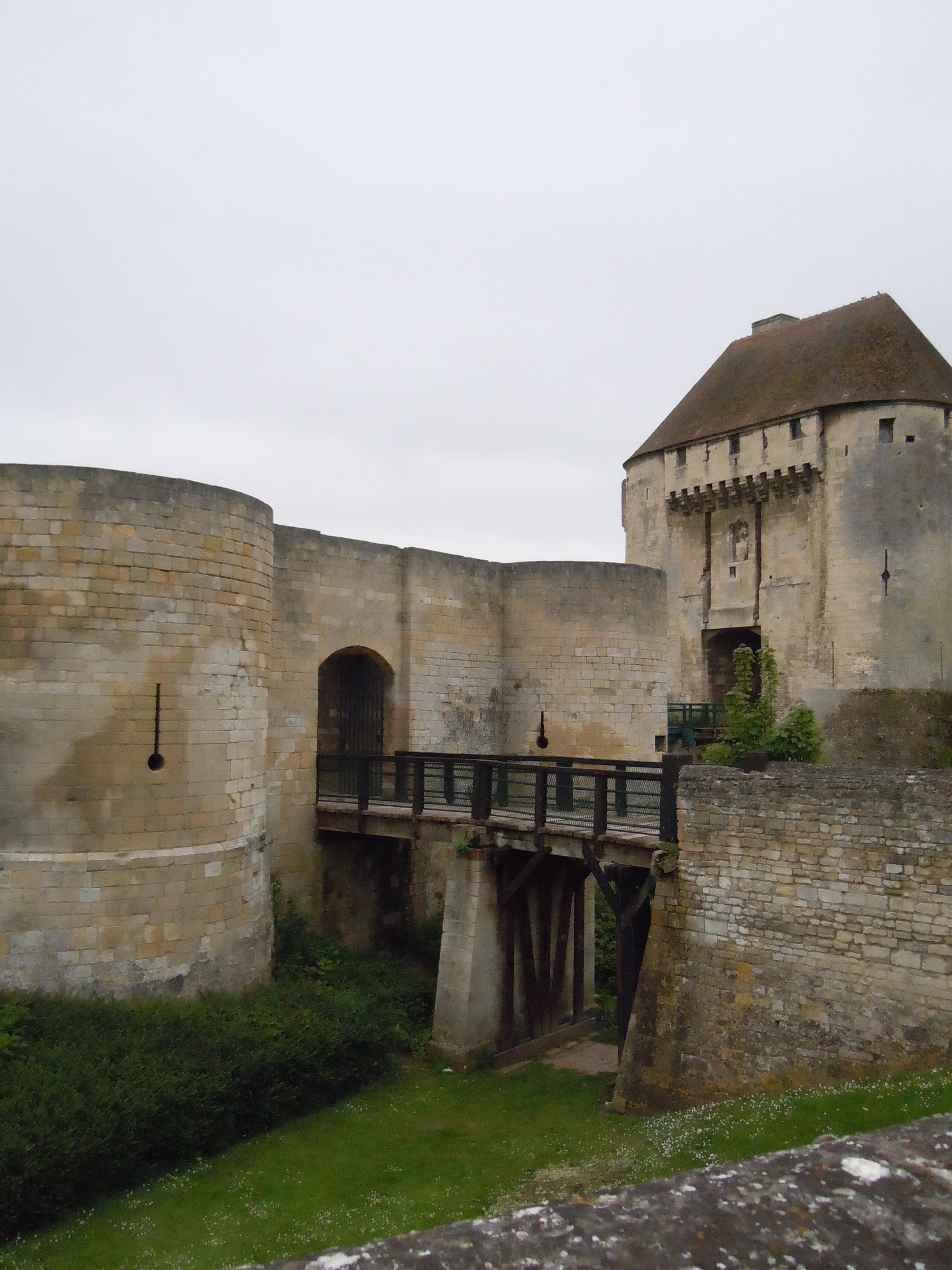
Since the dawn of time, William “the Conqueror” of Normandy had been destined to conquer. After all, it was his middle name. Son of Robert “the Duke” of Normandy and his irresistibly named mistress, Herleva, when he perceived that Edward the Confessor of Angloland was looking sickly, he rubbed his hands together with glee and envisioned taking over the isle to the north, wreaking havoc on its vowels and establishing Anglo-Normandy. In order to actualize his Cunning Little Plan of Wor(l)d Domination, he began to build forts — and not your typical cardboard and blankets forts — particularly on the brink of Northern France. One such force of battlement was erected at Caen. Little did he know that in actual fact if you want to get to England from those shores you actually have to catch a six-hour ferry from Ouistreham, calling for a taxi by Skype with mauvais français because the gulag of a hostel you got yourself into with doors that lock themselves after you exit closes its reception desk before 10 pm and doesn’t re-open until after you’re supposed to be at the docks, but that’s another story. The fact of the matter remains: he saw Caen as advantageous. Or perhaps Mathilda liked the view.

Nine hundred and fifty years later, to the day no doubt, a wandering scholar found herself facing a great surprise on the horizon of her travels:

*N.B. Will’s tacit endorsement of the E.U. But in actual factual, only the moat remains unchanged in any drastic fashion (apart from deepening). This may or may not be true.

A sweet view of the keep:

A fork in the road, allowing archers more options:

And some more photos thrown together since I can’t figure out how to be discerning with the gallery feature:

(Not quite sure how to use that gallery feature yet.)

In the fort was a church! On that church was a sign from my country and honouring people from the province I am currently residing in:

I pretended to be a soldier when facing these sights.

Clearly the canon does not date to William.

It was a little amazing to see how worn the steps are.

These pictures take a while to upload, and I am weary of weaving my tales. However, I did manage to bake pita bread and carrot muffins in the time it took to load them. Productivity score!

Fare thee well, fortress!

Normandy

After that first stint in Paris, I took a train to Évreux. A very small town, the librarians were very friendly, but apart from that there is not much for me to comment on.

Here is a picture of the main church, a mixture of styles:

Here is an historical mural on what I believe is a school:
I also took pictures of the St Taurin reliquary, but I’ve found better ones PLUS a description here.
I then continued to Caen. My romantic heart has been filled with stories of crossing the English Channel since I was a wee thing, so I was set on travelling to England from France by means of a sea-worthy vessel, even if I wasn’t going to be quite true to my novels with a departure from the almost mythical Calais. Caen was not only relatively in the ‘hood, but also boasted some medieval sites of interest. So I threw my lot in with Caen.
And what a profitable gamble! Hello, romanesque-blending-with-avant-garde-gothic architecture! William the Conqueror and Queen Mathilda stole my heart.
Mathilda’s Abbey for Women:
The holy water font was embellished with a couple of permanent inhabitants:
And on the outer façade, we find an intriguing trinitarian depiction of Christ:
Tune in next time for a tour of William’s fortress….

My Hobby

I’d like to be able to say that music is my #1 hobby. However, in all reality, my music hobby has almost entirely been reduced to a YouTube hobby. Having PhD obligations and no access to the instrument I know best (i.e. piano), I can hardly claim music as my hobby anymore. Woe is me.

So I plug into YouTube almost daily, looking for my fix. Recently a friend introduced me to a new piece, one of those I find definitely has drug-like qualities for me: addictive, mood-altering, potentially ruining my life for the power it has over me. Maybe I’m stretching the simile a bit, but I have been listening to it on repeat, and I do feel a bit at its mercy. I don’t understand quite how it enthrals me, but I know it has something to do with sequence of notes from 0:38-1:01. I hate scary roller coasters at amusement parks, but musically I find these sorts of drops and twists utterly thrilling. Add some brass fanfare at 2:25 to make it all feel a bit noble, and I’m captivated, even if I recognize the whole thing is a little repetitive.

I cannot understand why—perhaps there is a musical explanation, perhaps not—but this song is partnered in my mind alongside the enchanting Villa-Lobos song:

I’m having trouble understanding the connection my mind makes between the two songs. Is it harmonic? Melodic? Rhythmic, even? I’m much better at analyzing music on a page than with my ear. Can you tell this frustrates me? Ha!

My last confession is that I would absolutely love to see Sia’s song set to contemporary ballet, perhaps by dancers as incredible as Complexions Contemporary Ballet:

This link is totally worth following and watching.


Parigi, mia cara: Part 1

Having returned home with 1600+ photos on my camera, it’s been hard to motivate myself to sort through them. How do I organize them? Which do I choose? And what was the name of that church again? There were definitely a couple of strong themes running through my photos: the sacred (churches) and the natural (cows). As I wait for the clock to strike midnight so I can wish my sister, admittedly traveling Europe at the moment, an EST-stroke-of-12 happy birthday, I’ve decided to begin the great task. I am also well-fueled with beer, which makes the task seem less daunting.

So let’s begin with where I began, where I sat in the middle, and where I ended: Paris. A beloved city of mine, I spent enough time there this trip that I feel pleasantly satiated. Certainly, I would go back, but for now I am happy to be home.

Since we mentioned beginnings and endings, it seems fitting enough to introduce one of my first pictures, an ending by most standards, but traditionally a beginning as well:

Image

I quite admired the detailing in this relief found in Notre Dame Cathedral. They have made worm’s meat of him!

Here’s another ending/beginning from NDC. I don’t believe it’s medieval, but I’m not an expert in stained glass. Most of the stained glass in France, unfortunately suffered at the hands of rebels and wars (Chartres is a happy exception that I will happily post photos of in due time). Nevertheless, here is a beautiful piece of an historic moment: Image

Since I was 15, my favourite aspect of NDC has been the medieval wooden reliefs. These are one of the few decorative elements that have survived the centuries. They have, though, been repainted. I like these panels because they depict the Gospel stories through a flowing stream of pictures. In this section to do with the Nativity of Jesus, I’m especially delighted by the angel appearing to the seemingly miniature shepherds. Mary has an elegant way of lying after having given birth (in a pretty nicely fitted out stable, I must say), and I do believe that is the Christ Child cuddled up under the ox and ass. Image

Going outside, to a facade that has suffered much damage over the centuries as well but was reconstructed in the original style in, I believe, the 19th century (I really ought to dig out all those pamphlets I picked up so as not to distort the facts), we find St Denis holding his head and a couple of angels who don’t seem to know quite how to respond: Image

Angel on the left: Oh, um, you got that, Denis? Good, good. Um, yeah, you seem to have it all under control, so you don’t need my help, do you?

Angel on the right: This way to the Kingdom of Heaven, Dénis. Please mind the robes — no dripping, if you please.

~~~

Moving on from the Cathedral to the Musée de Cluny. I spent a glorious Sunday afternoon in this national museum of the Middle Ages. The temporary exhibit was on Cluny 1180, the third Cluny foundation and its demolition. That was relatively interesting, but the continuing exhibits are where it’s at. After having a picnic lunch in the medieval herb & pleasure gardens, I was soon faced with this statue of Adam.

The disembodied tour guide I was listening to informed me that Adam had been based on classical sculpture. I know little of such things, but it certainly looks like there was an attempt to imitate the ancients, whilst perhaps modernizing it a bit to keep up with hip medieval styles.

I was also excited to find this piece of rubble, which was one of the heads of the Kings of Judah that originally adorned the external façade of Notre Dame de Paris. It was reduced to its current pitiful state at the hands of French revolutionaries who apparently believed them to be the heads of kings of France. I’m not sure that it would have made much difference had they known the truth: kings are kings are kings.

If you look closely, you may be able to see traces of paint. Another limitation of trying to relive the Middle Ages with these cathedrals is that back in the day, they were painted all sorts of delightful colours. Over time the paint has worn away, of course. Can you imagine, though? An entire cathedral painted from head to toe? It must have been stunning.

No doubt they would have used colours similar those in this early 14th C. painting of the crucifixion:

Note Mary’s dramatic contortions. Her unnatural flexibility reminds me of Spanish crucifixes that express Christ’s suffering through a long-extended corpus. I personally find it very effective at communicating a symbolic message very quickly. Here the position of her arms also remind me that beside her is the baby she used to rock in her arms. The downward extension is balanced nicely with John’s stance. Altogether, a very beautiful, flowing, and moving depiction of the crucifixion in my opinion.

In this little statue, St Michael is fighting an apparently very stupid dragon:

Mary and John, who would have been placed under a corpus, probably in the cathedral of Prato:

After this, I took loads of pictures of liturgical implements for my own personal research interests, which I will not post here. Skipping ahead, then, here is the golden rose that Pope John XXII offered Rudolph III of Nidau in 1330. Avignon history, mes amis:

A tapestry commemorating St Stephen getting martyred:

Let’s take a closer look at that martyrdom:

I did also get to admire the tapestry of the Lady and the Unicorn. It was fascinating, especially the symbolism behind it. However, I did not take pictures, I think because it was forbidden. There are six tapestries in total: five depict the five senses, and the sixth represents her greatest treasure, the identity of which remains a mystery, be it love human or divine, or something else altogether.

Lastly, I offer you a devotional picture found on a retable triptych, I believe. Startling in its symbolism, I think especially to modern eyes not accustomed to such vivid pictoral representations of invisible truths, I found it both fascinating and almost embarrassing to gaze upon. Shoeing away my modern discomfort, however, I asked myself, What does this say about the late 15th C.?

The scene represents the Eucharistic sacrifice of the Mass. It appears to be the pope in his three-tiered papal tiara celebrating. It is evidently the Canon of the Mass, at which it is believed the Body and Blood of Christ appear on the altar under the form of bread and wine. It is interesting to note that in this picture, there is no bread (and, it would seem, wine) present. Instead, the pope is being treated to Christ’s very body having come down from the cross to stand on the altar, awkwardly, presumably as if in pain. And not only is His Body present, but He is squeezing from His the wound in His side, as if milk from a breast, His Blood. This sort of imagery is not uncommon in the writings of the mystics or even in Scripture, but it is startling when seen in a visual representation. All the more vividly does one comprehend that connection between Christ’s love for his people and a mother’s love for her child: she gives of herself that her child might live, just as Christ gives of himself that his children might have eternal life. It’s odd, but in its own way, it makes perfect sense. Behind Christ we see not only the double effect of the retable of the scene bearing another depiction of his crucifixion, but also symbols of his suffering, his torture, his betrayal. We have the cock that crowed at Peter’s denial, we have Pontius Pilate’s washing up, we have Judas’ kiss, the whips of torture and pillar for the scourging, the fists of anger and faces that spit, we have the ladder of deposition, the veil of Veronica, the hammer that drove the nails into his flesh. I think I even spy dice up in the shadows above the cross. The spear with vinegar, the spear that pierced his side. In a very elementary fashion, an entire narrative has been brought into a single picture.

After reflecting on this, I have to admire the genius of communication: so much in so little space! It is an excellent expression of medieval beliefs about redemption, salvation, the Eucharist, the interaction between man and God, etc. All laid against a heavenly gold background. Brilliant.

Oxbridge

Caen was intended as merely a night’s stopover before I took the ferry from Ouistreham (15 min. drive away) to Portsmouth and headed from there to Cambridge to meet my lovely friends, the Porters (they are both Masters and one almost a Doctor, but I shall call them Mr and Mrs, and the little Porter who is almost ready to face the world is Monkey Porter in my mind until he/she makes his/her grand appearance—perhaps in fond remembrance of my mother giving me younger sisters instead of a desired monkey). Anyway, the Porters are dearly beloved friends of mine whom I have known since my undergraduate days and whom I have almost always lived apart from since, catching up to them in the course of their wild adventures at Toronto for a year before they packed up for Cambridge. Where they will be come October when Mr Porter is Dr Porter is anybody’s guess, but one thing is for certain: fun and warmth will be there!

So to Cambridge I went, without too much mishap, though I did misunderstand my Megabus ticket and missed my train while I was waiting at the bus stop.

Cambridge was wonderful! I am all too conscious that my impression was deeply influenced by the company I kept and so I find it hard to be objective. We enjoyed good conversation and good food, and walked the charming streets of the town. Mr Porter let us into his college and his also the King’s College chapel with his VIP pass. We made a day trip to Wimpole Estate, once the abode of Rudyard Kipling’s daughter, and discovered we rather fancied the life of a well-to-do. The faux folly (for it was not a real folly, since it was apparently once used as fortifications) captured our imagination as well, and Mr Porter and friend, A., tramped across fields to see it up close and take photos for Mrs P. and I, who decided to recline on said fields with elderberry sorbet and strawberry ice cream, talking about Monkey Porter and the future and the past and society and life, as one does. Of all the rooms in the estate manor, I should say the library delighted me most of all, although I was rather fond of the embroidered linens I saw on a bed in the servants’ quarters! There were quite a few elegant rooms for meeting and dancing and eating as well, of course. I think Wimpole Estate was my favourite home-turned-museum that I have yet seen.

Mr and Mrs P. also took me to a college dinner, which we dressed up for. The supper was delicious, but unfortunately the crowd of undergrads (alas, I was not in town for a graduate affair) made it hard to hear each other across the table. Still, I felt I’d had a true Cambridge experience in that fine dining hall, being served under the auspices of famous college graduates. Another fine food event was the beer festival, which involved much mead and cheese!

Segue: ENGLISH CHEESE IS THE BEST. French cheese doesn’t even compete, and Canada, well, the affordable cheese in the supermarkets may not even deserve the name of “cheese.” The Brits are the Masters of Cheese. Every type of cheese they have mastered: cheddar, goat, soft, … you name it! I shall deeply miss English cheese and tea. I already do, even though crêpes filled with Emmental and baguettes slathered with camembert are not something to complain about!

Many other great adventures happened in Cambridge, but let us move onto to Oxford.

Oxford: “that other place,” as I was taught to call it, only to learn they do they same towards that other “other place.” Oxford was quite dreamy. Considerably larger than Cambridge and boasting broader streets than Cambridge’s narrow and intimate ones, I took to this place as well. Here the company was also lovely, as I met up with Younger Sister #1 and we hung about with our mutual friend who is doing her PhD in English women’s travel writing for Italy in the 19th C. here. Sister #1 also made the streets come alive with stories of her adventures here with a former prof of ours whom she met up with at a conference there recently… nothing like tales of hobnobbing with the upper crust of academia to make an academic centre a little more meaningful! It is the next best thing to experiencing it oneself.

I also spent some time in All Souls’ College library here. They were very friendly and have sent me emails of my needed folia.

My stay in Oxford was brief, but delightful. After two nights, we headed to Exeter, where she has been “studying” for the past term (“studying” in quotation marks since she has found the courses disappointingly undemanding, although that has allowed her to enjoy European life a bit more).

Now where was I? Caen we go back a bit?

The last little while has been quite busy and I’ve had little time to spare for the internets. Also, I’ve been meeting up with friends and family, so I don’t have spare time in the same way I did when I was travelling alone. I have a moment now as one of my traveling companions naps and the other two take a wander about Paris. It is our last full day, and perhaps I, too, ought to be wandering the streets this grey afternoon or at least surveying a museum’s display, but I think I’m fighting a bug and am taking a slow day. After all, I’ve already had quite a lot of time in this delightful city and I will be back for a few days on my own before my flight back home. I have been taking lots of photos, some of which I hope to upload upon my return, but for now I shall simply update you on recent happenings.

Following Évreux, I spent a day in Caen. It was Assumption Thursday, so the museum was closed but there were lots of families about in their Sunday best and it seemed there was a feeling of festivity in the air, despite the mildly gloomy weather. The greatest monuments of interest—the fortifications of William the Conqueror and the abbey churches built by himself and Queen Mathilda—were open to the public (of course!). It was my first encounter with the Romanesque, and I was taken aback by its beauty. I had not been expecting that, for all the pictures I’d seen of Romanesque architecture appeared to me to be quite dull and bland, but once I was there, faced with the creamy stones and the light flooding into the churches, I understood the beauty of the simplicity of light in a naked church. The soft, rounded arches, along with simple detailing such as what I call the “checkered effect,” were a pleasure to look upon. What a tremendous joy! I took many photographs, especially of the men’s abbey, which, for a humble abbey church, was enormous! This men’s abbey was also remarkable for its unity of architectural execution, seeing as the apse was rebuilt in the gothic era—yet the architect in charge (I forget his name) ensured that there would be no sense of interruption or disunity in the plans, and the gothic arches blend in so well that I did not notice a difference between the apse and the rest of the church until the guide pamphlet enlightened me (mind you, I have only just been acquiring an eye for medieval architecture as I’ve been here, as there is none to examine at home). It also thrilled me to be standing in the footsteps of Lanfranc, who assisted William in the building’s execution. The building was so gorgeous I could almost understand the impulse to become a monk. It is truly a peaceful place. Oh yes, and the dome was also rebuilt, I think in the 19th C. or so (I might be making that up, as it’s been a while since I was there and I tend to forget dates), but in the original style. It took all the feistiness of a young monk novice to preserve the medieval church and rebuild it in its original style. The church acted as an infirmary during WWII, and there are pictures of nuns and nurses attending to the injured and traumatized and hungry in the side chapels. Fascinating. Happily, neither abbey church suffered during the bombings.

I passed by another church in Caen that had suffered greatly during the bombings, though—all its stained glass had been destroyed and the church itself had been reduced almost to rubble (though you could distinguish some of the older parts of the walls because they were off-angled and tilting oddly). Through my mind flashed, upon witnessing this, a very small sense of what it must have felt like to discover that one’s beloved home parish, the parish of one’s father and great-great-great-great-[…]-grandfather, had been destroyed. The stained glass that you see there today is quite ugly, for either they had no taste or no money after the bombing. It is a little heart-breaking.

William’s fortifications were also thrilling. Again, I walked about trying to envision medieval archers scrambling about the walls and up the steps. I observed the various additions that had been made over the centuries, most notable by the evolution from arrow slit to artillery keyhole (proper terminology, bien sûr!) in the walls. I walked in the moat and across the bridge, and there was a church inside as well, though it too had suffered during the war, I think (sometimes I forget whether damages were due to the great wars, revolution, or Protestants, but it’s typically one of those three when it comes to medieval stuff). I really delighted in the ruins, but I know much less about battlements than I do about churches, so I have much less to comment on here. The pictures will have to speak for themselves.

Evreux good thing must come to an end…

It’s my last night in Evreux, for tomorrow I head to Caen, where I intend to check out the abbeys established by William the Conqueror and Mathilda.

This town has been a delightful respite. Not only the town itself, but the librarians have been lovely. In Paris I had to jump through a number of hoops daily just to enter the library and receive a manuscript, which they would give to me grudgingly, with heavy reminder of my time limit. It was Asterix and the Mansions of the Gods: bureaucracy at its finest. Understandable inasmuch as it is a massive operation of an institution, but how charming to come to a small ville’s local library, be given a manuscript after filing out a humble form, having the librarians offer me a magnifying glass, coffee, words in French that I don’t quite have yet and a patient smile when I try to express myself in the language. I was touched. I almost wanted to hug them when I left today. I do hope my research demands a return trip… Personally, I think one will be necessary, since there are no microfilms of these two manuscripts.

The room I worked in was quite charming as well. It was on the top floor of an 18th-century building (if I remember the century correctly… It was very modern, at least, by my standards). A tiny room whose curved wall faced west and so enjoyed the afternoon sun, and in which were but three small tables for visitors and a librarian’s desk. Much of the time, I was the only visitor, but the first afternoon it was quite busy: there were three!

The town itself is fairly unremarkable, yet it has its attractions. It is my first Normandy experience, so I find the architecture fascinating. There is a bell tower, begun in the twelfth or thirteenth century and completed in the fifteenth. There are a few Roman wall ruins extant. Charles the Second, 14th C., was responsible for a promenade along the river (looked more like a brook or stream to me). And there are two churches that were begun in the middle ages: Notre Dame and Saint Taurin (a local saint of early centuries). St Taurin’s was turned into a salt pete (?) factory for several years around the Revolution. It resumed its ecclesiastical duties in 1803.

The ecclesiastical music here is also fascinating to me. There are the schmaltzy French tunes reminiscent of the Lourdes favourite, Immaculate Mary, but many of the melodies appear to have very old roots. One hymn reminded me of a medieval French carol I know, and a couple others were reminiscent of some tunes of the crusaders and knights templar that I’ve listened to on YouTube–a strongly militaristic rhythm. It is simply incredible to be connected to this history not only spatially and visually and tactilely, but also audially. Though the world around me is of the twenty-first century, I feel like I have one foot in the thirteenth century. I am a not just a historian: I am a time-traveler! 🙂

Long time no writes

It’s been a while since I’ve had time to write. After a very fast five days in Paris, which included hobnobbing around the Bibliotheque Nationale and stopping by every medievalesque church and attending the Musee de Cluny with special exhibit “Cluny 1120” (leading me to weep once more over the inhumanity of the French revolution–the vandals! Worse than the germanic barbarian hordes!), I have reached Evreux, where the librarians are much more friendly and I am altogether a happier scholar. I do love Paris, sans doute, but big cities are best enjoyed when one has somewhere quiet to go to after a long day at work–not a hostel.

Being in France is luverly. I would love to stay here longer and really improve my spoken skills, for as yet I understand well, but am something of a mute, that occasionally grunts incomplete sentences. “Je suis…” and “peut-etre l’autre porte….” For a few days there I had a sore throat, and I blame it on the French “r”s I was practising in imitation of people on the metro saying “pardon.”

Manuscripts are fun, but I have to laugh at the idyllic scene I’d been envisioning since undergrad… My dreams certainly hadn’t included aching back and neck, nigh bleeding eyes, anxiety over time pressure, and skipping lunches regularly. Yet still I love it. It must be true love….